
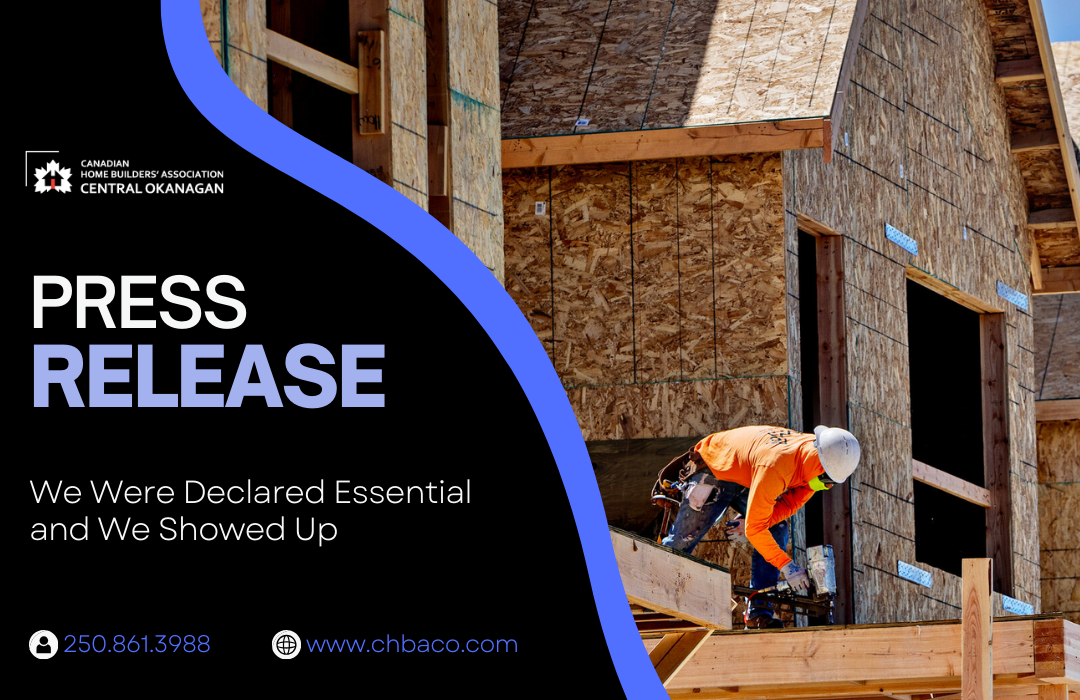
We Were Declared Essential and We Showed Up
Open letter to Kelowna Mayor and City Councillors,
There was a time, not long ago, when Kelowna needed residential construction more than ever—when tourism shut down, when restaurants closed, when offices emptied and when families were unsure how they would make it through the month.
Residential construction did not stop. We were declared essential and we showed up. We faced historic supply chain disruptions and material prices skyrocketing. Lumber volatility alone added tens of thousands of dollars to homes. Windows, appliances, trusses, and mechanical systems were delayed for months.
In many cases, builders and trades absorbed increased costs because contracts were already signed. We kept building because the community needed stability.
Residential construction helped carry Kelowna’s local economy through crisis. Today, we are writing because that same industry is under extraordinary strain.
The average Kelowna home builder builds three to five homes per year. These are not large corporate developers. They are small local businesses. They are parents, volunteers, sponsors of youth sports, active members of this community.
Some of our members have not pulled a permit in over two years. When builders stop building, the ripple effect is immediately felt in our local economy where we are a top four employer and in many years, out perform tourism.
Kelowna’s unemployment rate surged into double digits this past year, ranking among the highest in Canada at times. Residential construction slowdowns are a key contributor.
Our vacancy rate is one of the highest among Canadian metropolitan areas. While the increase in rental product has contributed to this so has the fact that residents, particularly those employed in the residential construction industry, are leaving town.
At the provincial level, bankruptcies are rising. British Columbia saw insolvencies increase by approximately 10% year-over-year a clear sign that our broader economy is fragile and that B.C., and Kelowna in particular, are no longer in a bubble.
Single family homes have been pushed out of our community by permanent growth boundaries, which any economist will tell you that is a sure way to increase housing prices.
So we were told to adapt or die. “Build more carriage homes,” we were told, while at the same time, Development Cost Charges on carriage homes were increased to more than $25,000 per unit, a dramatic escalation compared to previous years. Off-site requirements and servicing standards have compounded those costs.
For small-scale builders trying to deliver infill or missing-middle housing, those charges often determine whether a project proceeds or dies. And of late, they have been dying.
Residents invested in housing—including short-term rental options—in full compliance with the zoning rules in place at the time, only to have those rights removed after the fact. As a result, many have lost hundreds of thousands of dollars in property value, pushing some families to the brink of bankruptcy.
We have attempted to pivot in the direction policy has encouraged but the cumulative effect of zoning removal, escalating fees, off-site requirements, and servicing constraints has effectively eliminated an entire segment of attainable homebuilding in our city.
Here is what is most concerning—the desire for homeownership has not disappeared. According to a national Abacus Data Poll commissioned by the Canadian Home Builders’ Association, 88% of Canadians under 45 still aspire to own a home. Yet only 29% believe that dream is realistically within reach. And fewer than one in five Canadians believe governments are doing enough to address homeownership affordability
Homeownership remains deeply important to young Canadians. Yet over the last decade, municipal policy has increasingly deprioritized ownership housing in favour of other forms of tenure, as if the aspiration to own is outdated. It is not.
Young families in Kelowna still want a front door, stability, and the opportunity to build equity. They are frustrated. They are watching prices remain high. They are watching supply stall. They are watching opportunities shrink.
A healthy housing market must include attainable ownership options. It must include small builders who can respond quickly and flexibly to community needs. It must include the next generation of trades who see a future here.
Kelowna’s economy is not immune to provincial trends. British Columbia is experiencing economic fragility. Out-migration to Alberta and other provinces continues and small businesses are under immense pressure.
If local builders disappear, rebuilding that capacity will take years.
We are asking council to:
- Recognize that ownership housing is not the enemy of affordability, it is part of the solution.
- Review and recalibrate Development Cost Charges and off-site requirements particularly for small-scale projects.
- Evaluate the cumulative impact of recent zoning and servicing decisions.
- Align municipal Energy Step Code and Zero Carbon Step Code requirements with provincial minimum standards and refrain from additional acceleration until homeownership affordability measurably improves.
Residential construction helped carry Kelowna through crisis and now we are being left in the dark to quietly erode. We need leadership now that recognizes the importance of ownership housing, and a balanced housing ecosystem.
You may have given up on the dream of homeownership for many of Kelowna’s citizens but that doesn’t mean we have.
Krista Paine, Board President and Cassidy deVeer, Executive Officer,
Canadian Home Builders Association – Central Okanagan
Media Contact:
Cassidy deVeer
Executive Officer
Canadian Home Builders’ Association – Central Okanagan
cassidy@chbaco.com
250.861.3988